In the hours leading up to the MV Hondius’ arrival at the industrial port of Granadilla de Abona, in south Tenerife, there was an escalating war of words that laid bare the tensions between the two administrations involved in managing the hantavirus outbreak.
The president of the Canary Islands government, Fernando Clavijo, accused the central government of failing to respond to a specific request: that passengers still awaiting transfer be flown out on a Spanish military aircraft which, he said, had capacity for 210 people but was due to travel with only 14 on board.
On Saturday afternoon Clavijo had held meetings with three ministers – Health, Interior and Territorial Policy – without receiving a satisfactory answer to that demand. Faced with this, he announced that he would instruct the Port Authority not to authorise the ship to anchor.
The response from the central government came an hour and a half later in the form of an official document. The Directorate-General for Merchant Shipping, in a letter signed by its director-general, ordered that the MV Hondius be received in Granadilla “given the need for medical assistance on board and the possible worsening of weather conditions”.
The text added that health controls were more effective in port than leaving the ship indefinitely at sea. Clavijo responded immediately: the cruise ship was not going to anchor “with the authorisation of the Canary Islands government”. He then went on to say if it anchored on the orders of the Spanish government, “they would be the ones responsible for whatever might happen”.
In the end, the cruise ship dropped anchor in the port of Granadilla at around 06:30 on Sunday, local time, and disembarkation of the first passengers began at about 09:40, local time. The first to come ashore were the 14 Spanish citizens, who boarded a coach from Spain’s Military Emergencies Unit (UME) escorted by the Civil Guard and headed for Tenerife South airport.
The operation on the ground: an orderly evacuation
While the disagreements between administrations were being thrashed out, the health and interior ministers and the WHO director-general were overseeing preparations at the port of Granadilla on Saturday night.
Health minister Mónica García confirmed that the passengers remained symptom-free and set out the operational framework clearly: the cruise ship was to anchor inside the harbour basin with the help of a tug, and passengers were to be brought ashore in staggered groups according to nationality and in line with the flights available.
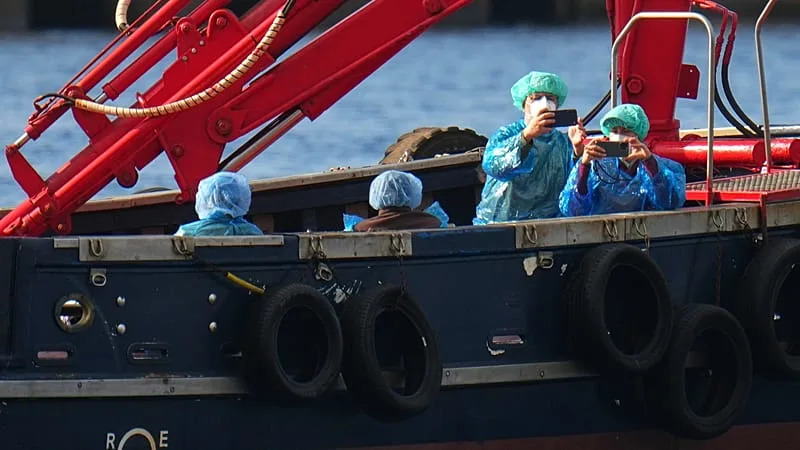
No one disembarked with luggage: each passenger was only allowed a small bag with documents, phone, charger and basic necessities. Everyone was wearing an FFP2 mask, as were the logistics staff and the bus drivers.
In all, 23 countries have been affected by the hantavirus detected on the cruise, the health minister confirmed. The last passenger flight is scheduled to leave Tenerife on Monday afternoon, bound for Australia.
Interior minister Fernando Grande-Marlaska said on Saturday that most of the planes needed were already in Tenerife and that the remainder would arrive the following day.
Minister García, for her part, explained that the decision on whether the ship would anchor or berth depended on several factors: the Maritime Captaincy, the port authorities, sea conditions and health conditions.
The European Commission also activated the EU Civil Protection Mechanism, through which Norway sent a rescEU air ambulance to Tenerife, while additional transport capacity from other member states was kept on standby.
WHO calls for calm in Tenerife
The director-general of the World Health Organization, Tedros Adhanom Ghebreyesus, flew to Tenerife to oversee the operation and delivered a direct message to the island’s population.
“We understand the concern because we all have the experience of Covid and that trauma is still present in our minds, but the situation now is much better,” he said.
He also recalled that the International Health Regulations oblige countries to cooperate, and said he was grateful to find in Spain “a strong conviction of solidarity”.
On Friday the WHO had confirmed six of the eight initially suspected cases and said there were no suspected cases still pending on the ship. The MV Hondius, which sails under the Dutch flag, left Ushuaia, Argentina, on 1 April for a cruise in the South Atlantic.
The outbreak, which has caused three deaths and affects passengers of 23 nationalities, was preceded by weeks of negotiations and refusals: Cape Verde did not authorise disembarkation, and Spain took several days to accept the WHO’s request before setting in motion the operation.
This text was translated with the help of artificial intelligence. Report a problem : [[email protected]].