PICASSO exhibitions are fixtures of the art calendar, but rarely are they opened by a queen and a cardinal. In Burgos Cathedral’s new gallery, Queen Sophia of Spain and Cardinal José Tolentino de Mendonça, Prefect of the Vatican Dicastery for Culture and Education, attended the first day of “Picasso’s Biblical Roots”. Neither the bone-chilling cold in the Chapel of Constables, nor still being immersed in the 15-day orthodox mourning period for her late sister, dulled Queen Sophia’s smiles for the dignitaries inside, and crowds outside, the 13th-century Gothic cathedral.
Located in the cloisters, the new gallery provides the level of security and climate control for Burgos to become a venue for high-level exhibitions, offering the conditions necessary to secure loans of prestigious artworks nationally and internationally.
Picasso visited Burgos, in north-east Spain, in 1934, on what was to be his last ever trip to his native Spain. He was accompanied by his son Paul and wife, Olga. The year after the family holiday, Olga and Picasso separated, Marie-Thérèse Walter gave birth to his daughter Maya, and he entered a relationship with the surrealist Dora Maar. Paul’s son Bernard Ruiz-Picasso, founder of the Picasso Foundation in Madrid, is a leading figure in the realisation of this exhibition.
Picasso was a “pious atheist”, the curator, Paloma Alarco, says. As a child, Picasso attended mass with his mother, and his artist father, José Ruiz y Blasco, created a copy of Pedro de Mena’s sculpture of a Dolorosa for the family home. At the age of 14, Picasso moved from his birthplace, Málaga, to Barcelona, and studied at the atelier of the religious painter José Garnelo y Alda. Influence of Alda’s naturalistic style and moralising subjects is clear in Picasso’s first large-scale work, First Communion, presented to the 1896 Exposition of Fine Arts and Crafts, in Barcelona. The popularity of scenes of contemporary devotion in Spain on the eve of the 20th century is demonstrated in Burgos’s opening works, also painted in 1896: Altar Boy Giving Oil to an Old Woman and the larger, single figure The Altar Boy.
 Fundación Almine y Bernard Ruiz-Picasso, Madrid © FABA Photo Hugard & VanoverscheldePablo Picasso, Maternidad (“Maternity”) (Fontainebleau, 10 July 1921). Oil on canvasAs Picasso progressed beyond his teenage precocity, he turned his back on overtly Christian subjects, but the sensibility and symbolism of his Spanish Catholic upbringing left their mark. The Burgos show emphasises overarching parallels between devotional practices and Picasso’s quest to render the invisible visible through artistic innovation.
Images of the Virgin and Child are a pillar of Western art. In Maternity (1931), echoes of devotional images are present in the way the mother inclines her head tenderly towards the bouncing baby on her lap. It was painted shortly after Paul was born, the neoclassicist monumental style lending Olga the air of a fertility goddess in a pose associated with Christianity.
In early drawings, Picasso’s debt to religious painting is more explicit. Mother with Child Praying (1899-1900) captures a careworn duo in the minimum of dark pencil strokes. An ink drawing from the same period, a study for a charity poster, Mother and Child, shows a mother bowing her body to protect her family from unseen hardships.
A poster design for the World Congress of Peace in Paris in 1949 made Picasso’s biblical doves a symbol of peace worldwide. A simple line drawing, Dove-Face (1955), and a card, Dove (1952), with squares of colour, show the versatility of the paloma in Picasso’s hands.
The Man With a Lamb (1961), a sculpture made from folded metal, mirrors the technique of folding and cutting paper which Picasso used in play sessions with his children. The Good Shepherd figure, wearing a blue loincloth on his brown metal body, with skeletal detail, envelopes a sheep in one arm and holds a staff with the other. Earlier drawings of the subject, made in the early 1940s during the Nazi occupation, depict a naked figure and large, unruly lamb, underlining the humility, labour, and possibly weariness of the shepherd.
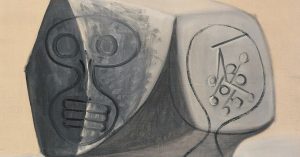
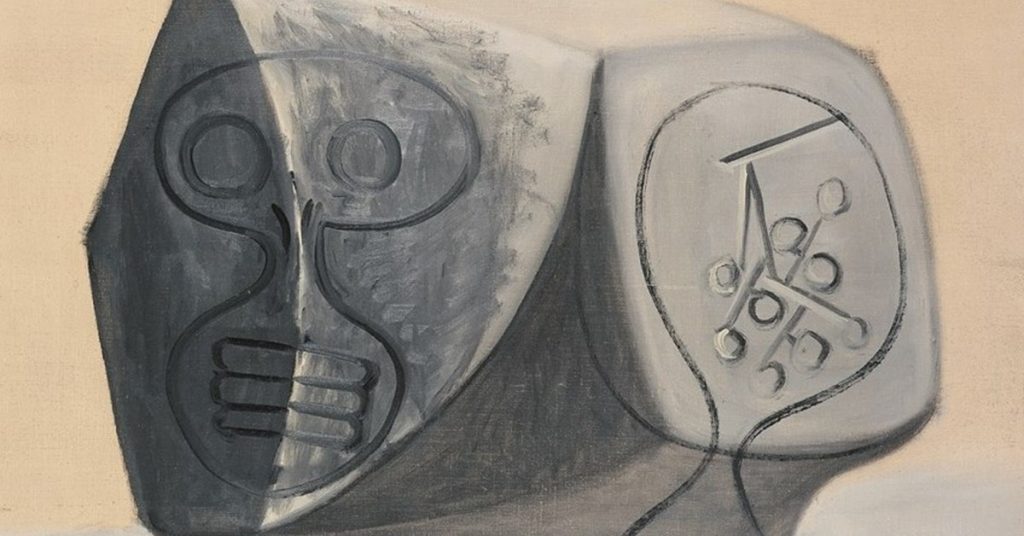
Reworking images connected to the Passion was also a constant throughout Picasso’s career. Even when he was living in the south of France in the 1950s, the war-torn Paris years a receding memory, his bronze sculpture Man (1958) resembles a wooden Cross with V-shaped crossbeam for arms, and base split in two for legs. Skulls, recalling Golgotha, are also a motif of his work. Skull (1943-46) (Calavera in Spanish) reproduces the symbol of death and suffering in six marks of black, two eye sockets, four teeth, on a brown outline. But the symbol is also ornately reworked as a vanitas in the aquatint Goat Skull on the Table (1953). Neither simple nor complex treatments can obscure or evade death’s inevitability.
Describing Catholicism as Picasso’s “personal alphabet”, Cardinal Mendonça continued: “The body of Christ is an archetype of human suffering, a shape that contains suffering without explaining it.” For Cardinal Mendonça, Picasso’s anti-war work Guernica exemplified a theology of mercifulness. “Guernica is the human condition without a veil. It is the greatest religious picture of our time, not because it contains dogma, but because it captures humanity.” Picasso’s grisaille, all-grey, postscript to Guernica, Mother with Dead Child II, is on display in Burgos. The kneeling mother, mouth agape in sorrowful cries for her dead child, depicted horizontally, resembles a pietà.
“Picasso’s Biblical Roots” is at Burgos Cathedral, in Spain, until 29 June. picassoraicesbiblicas.com