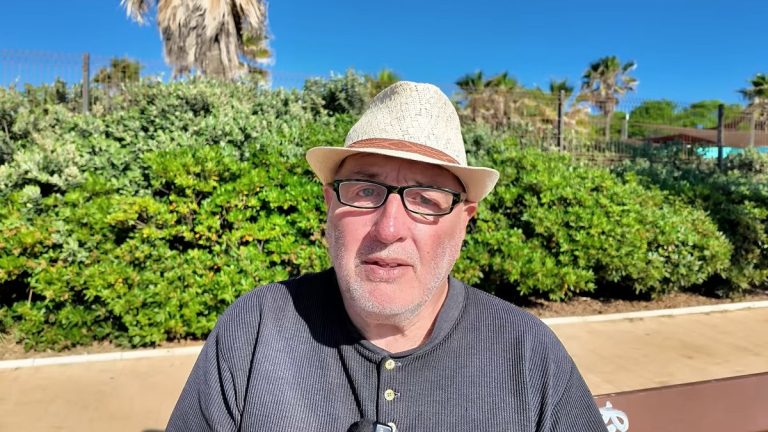
Mark Danby swapped Stockport for the Costa del Sol 18 months ago and loves life as a British expat in Spain – but there are still three things he misses about home

He made a new life for himself in Spain relatively easily
Approximately 400,000 British nationals are officially registered as residents in Spain, though some estimates suggest the actual figure could be closer to a million. They are attracted by the more temperate climate, relaxed way of life and – it has to be said – the abundance of fellow English-speakers, which makes the language barrier far less daunting.
While expats gain considerably from their move to Spain, many acknowledge there are things they find themselves longing for back home. Mark Danby, who chronicles his life on the Costa Del Sol through his Tapas Guy YouTube channel, told the MEN that it’s only when he returns home that he realises there are three things he truly misses.
Pubs
First on his list is that quintessentially British institution – the pub. “One thing I do really miss, as much as I like the Spanish bars, it’s a good old English pub,” he explained.
“Every time I go back, the first thing I want to do is go into a pub and have a pint of beer.”, reports the Manchester Evening News.
There are, however, signs that a taste of British pub culture is making its way to Spain. Wetherspoons recently launched their first establishment in the country, at Alicante Airport.
British food
There’s no denying that Spain boasts an impressive and mouth-watering culinary scene – from tapas to paella. Yet Mark admits to yearning for the home comfort of a classic fish and chips. He continued: “You can’t get good fish and chips here… maybe if you go to Gibraltar, I’ve had some decent fish and chips, but you can’t get fish and chips round here that are decent. Fish and chips, steak pie and chips, stuff like that.”
Family
And naturally, Mark doesn’t see his family as frequently as he’d prefer, though he notes his 29 year old son is also considering a move to the Costa Del Sol.
Mark’s life in Spain
Mark clarifies that, despite the reduction in international flexibility following Brexit, it remains possible to relocate to a European nation under specific circumstances: “I’m on what’s called the digital nomad visa,” he explains.
While residing in Spain, he essentially operates in the UK thanks to reliable broadband. He went on: “You can work, but you can’t work for a Spanish company, or anywhere in Spain.
“So I can do remote work and so can my, so can my son. So we can be located out here, and we’re not taking any Spanish person’s job away from them, we have an income, and we can work remotely.”
In Mark’s most recent video, he contemplates how it’s all too simple to become stuck in a routine and lose your appetite for adventure, explaining: “One of the strangest things about getting older is the older you get, the harder change becomes. Not necessarily because life gets worse, but because the life we know starts to feel much safer.”
He explains that he relocated to Spain roughly 18 months ago, but recently returned to visit his former hometown in the UK for the first time in quite a while. “I started to think quite a lot about this because part of me feels deeply connected to it. The streets, the routines, the familiarity,” he says.
“When you have lived in a place for decades, it becomes part of who you are, part of your DNA. And walking around there again reminded me how easy it is for years to quietly pass by without much really changing in your life.”
He tells us that the “big leap of faith” of uprooting your entire life and moving to another country isn’t for everyone, adding: “Some people find out it’s not for them. They find out that living here is not the same as being on holiday. It’s very different in winter than it is in the summer.”
That said, Mark explains that in many respects he actually favours the Spanish winter over the summers, which can be ferociously hot. “it’s just too hot to do everything,” he says. “You’ve got to turn your life around.
“I’ve got a dog, so it’s early morning walks, it’s walks after sunset. You can’t really go out and do anything during the day. It’s too hot to walk anywhere. So you live your life in the evenings and late at night.”
As a result, Mark adds, he appreciates how Spaniards developed their tradition of taking a mid-afternoon siesta and dining considerably later in the evening. While Mark has wholeheartedly embraced Spanish culture, he has yet to get to grips with the language: “I do make an effort,” he says, “not as much as I should.”
Matk told us: “To be honest, you don’t really need it on the Costa del Sal, because everybody speaks English. There’s lots of English people and and …there’s a lot of Dutch and Germans and Belgians, and most of them speak English.”
“I’m close to La Duquesa, which is an international port,” he adds. “Everybody speaks English. So, you know, there’s nothing forcing me. The only problem is when you come across bureaucracy.
Even so, he notes that certain aspects of Spanish life, such as purchasing property or arranging car insurance, are considerably more straightforward than one might anticipate.
He goes on to say that he currently has no intention of heading back to the UK: “I’m not planning on coming back, but you never know, do you? I mean, you never know what life’s going to throw at you, health wise and all the rest of it.”