Editor’s Note: This story originally appeared on Live and Invest Overseas.
Karen McCann is a California native, a writer, and a long-time expat. After spending lots of time in Spain, she and her husband decided to make a permanent life there about 20 years ago.
Kat: Spain is one of the top retirement destinations in the world and it’s very close to my heart—but I’ve never been to Seville, one of the top retirement destinations in the country.
Karen, can you tell us a little bit about your background prior to your move and what prompted that?
Karen: Well, I am a fourth-generation Californian, which is a rarity. My great-grandparents came across by covered wagon, and I think it’s given my family a sense of adventure. We tend to go places and do things.
I have always traveled—even when I had zero money and it was all backpacking and hostels.
Now I am a writer and I organize travel around what I want to write about.
My husband loves to travel too; we have been to over 60 countries. We enjoy learning about new things, new people.
About 25 years ago now, we had friends who were in southern Spain and invited us to visit. We just fell in love with the area. It was the romantic, charming lifestyle that we’d always envisioned in Europe.
We thought, “Well, let’s just spend a little more time here… and then a little more time… and some more time.”
That turned into, “Why don’t we come here for a year?”
That was 20 years ago.
I think moving abroad is one of the most interesting things you can do. You get to hit the reset button on your life. It’s the best chance to reinvent yourself outside of the witness protection program!
Everything is new, everything’s fresh, everything’s different. Life couldn’t be more exciting. Sometimes it drives you crazy, but that’s true anywhere in the world.
How Seville has changed
Kat: You’ve spent so much time in Spain now and yet you’re still in the same location that you originally fell in love with. It must have changed over the years.
Karen: The city has changed enormously.
When we moved here, there were hardly any tourists. There were no tours. There was nothing commercial. And now it is full of tourists—to the point that it’s driving everybody crazy.
But it’s still a wonderful and livable city. It’s a safe city…
And it still has shopping! In America everything is done online now. The stores in my area are disappearing fast, and it’s delightful to be able to come to Seville and actually walk around a shopping area.
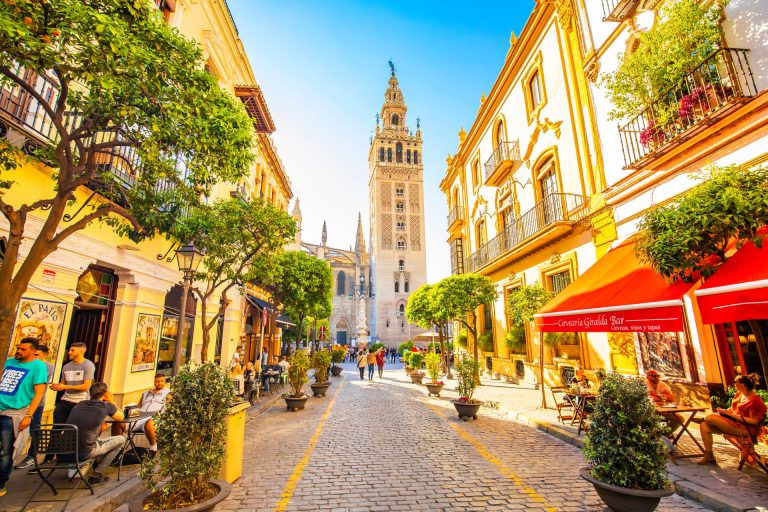
There’s a vibrant street culture because of the weather, so people live outside more here, more so even than in California. It’s very refreshing, and that has not changed.
Splitting time between Spain and the U.S.
Kat: And you must have done so much more exploring of the country in those interim years… So what has held you to Seville? Have you ever thought about moving to another city?
Karen: Well, we actually split our time between Seville and California, so every six months we move from one to the other. The lifestyle evolved naturally over the years.
We have friends, family, doctors, and business interests in the States that we like to keep in touch with.
And America itself! America has something that you have to stay in practice for, and I don’t want to lose my touch.
I often advise people to try the part-time lifestyle. People seem to get the idea that it has to be an all-or-nothing situation. It’s not like crossing in a steamer ship in 1812! If things don’t go well, you can pack up, go back home, or try something else.
But we never looked back.
Kat: So do you own a car there?
Karen: No, which is really wonderful.
It’s one of the big pros of living in a European city—the fact that you can go car-less. It’s so freeing and promotes living outdoors more. You’re walking everywhere; it feels healthier.
The local diet
Kat: What about the local diet? The Mediterranean diet in Spain is famous as one of the healthiest in the world; it supposedly even beats Alzheimer’s.
Karen: I pay a lot more attention to food when I’m here.
I’m from California in a very foodie area near San Francisco.
But in this area, people really have a tradition of sitting down and enjoying meals—not inhaling fast food in their car, which they think that’s an abomination.
They cannot understand why anybody would even have a cup holder in their car.
Stopping for coffee is a big part of life here. Every expedition I’ve ever been on, every road trip with Spanish friends, for example, we go about an hour and we stop for coffee. It’s just a given; it’s automatic and delightful.
The idea that every meal should be an experience, in convivial company, sharing great, healthy food, and usually a little wine with it—why not?
Cultural expectations
Kat: Your experience coming into this part of the country 25 or so years ago would be very different, I imagine, from somebody who’s just coming in now.
The path must be much more smoothly paved…
What do you think the biggest challenges or culture shocks might be for somebody coming into today’s Seville?
Karen: You do still have to learn Spanish. When I moved here, nobody spoke English. Not a waiter, not even hotel staff… no one spoke any English. And of course, that was long before we had Google Translate and all that handy stuff.
In order to integrate into any society, you really need to learn a little something of the customs and a lot about the language. Even now, with all the changes, it is really important to focus on getting some background in the language so that you can interact with people.
That said, it all is much easier now. The number of people who speak English, the number of ATMs, everything is more modernized and internationalized. Everybody takes credit cards; everybody has gluten-free options on the menu.
It’s a different world.
But if you get outside of the main area, it starts to go back to the old ways. And that’s sort of wonderful for me because I love the old-fashioned ways. So, my husband and I frequently, particularly on Sundays, we’ll just start in a direction, wander out into some area around Seville and try a new café or bistro that looks really old-school to us, and we’ve had amazing meals for really inexpensive amounts.
Semi-retired life in Seville
Kat: So give us a little tidbit of a day in the life for you. You’re a writer, so I take it you’re not completely retired here.
Karen: Yes, I am a writer, so I will never be fully retired. Every couple of years I put out another book. Writing compels me to get out there, so I never want to give it up.
I don’t have a 9-to-5 job or a boss. I don’t have to worry about any of that stuff. So in that sense, I am retired and I’m completely flexible in terms of my hours and what I do.
I usually write in the mornings because I’m a morning person and one of the huge advantages of Seville is that we still follow the siesta culture—which means that I have 14 mornings a week. It’s fabulous for me. I have that get-up-and-go… that energy twice a day!
The psychology of it is really something for morning people. You don’t sleep long, 20 minutes or so, but it’s that complete break in the middle of the day. I really miss it when I go to the States. I still take siestas there, but somebody is always ringing my doorbell or calling. The rest of the world doesn’t take their siesta.
But back to a day in Seville… Around noon or so, my husband and I go out and take a walk and explore, or run mundane errands, but we always get an hour or two of walking in per day. We often eat out in little favorite cafés—we are extremely blessed with good weather here. We often eat outside at lunchtime in January.
Then we take our siesta.
I might do some more writing and/or do emails before going out again.
It’s a very sociable culture, so we go out a lot in the evenings.
Last night, for example, we were out with a group of friends that joined our “Ideas Club.” It’s like a book club, but we talk about ideas. We went out to dinner with them all to celebrate a birthday.
It is so important to embrace that social atmosphere, because being an expat can be a bit isolating at times, especially in the beginning.
Whether it is only expats or other foreigners or other English-speakers, you have to build a community. Slowly but surely, it becomes easier to make local friends, after you’ve been there a while, you speak some of the language, and you’ve become part of the community rather than a new addition.
Tax residency
Kat: So if you’re splitting your time, are you officially resident in Spain—or tax resident—or is your home base officially still in the U.S.?
Karen: I am a permanent resident of Spain, which means I can stay here pretty much year-round, indefinitely.
However, in order to avoid becoming a tax resident, we don’t stay here year-round. That’s part of why we do the six-month on and off thing.
We are not technically required to become tax residents unless we spend more than six months here, but in order to maintain residency, you’re supposed to spend six months in country… So we hit that sweet spot in between, and it works really well for us.
It’s a very revitalizing process to pick up your entire life twice a year!
We have great friends on both sides of the Atlantic.
We are so pleased and feel so fortunate to have this lifestyle to pursue.