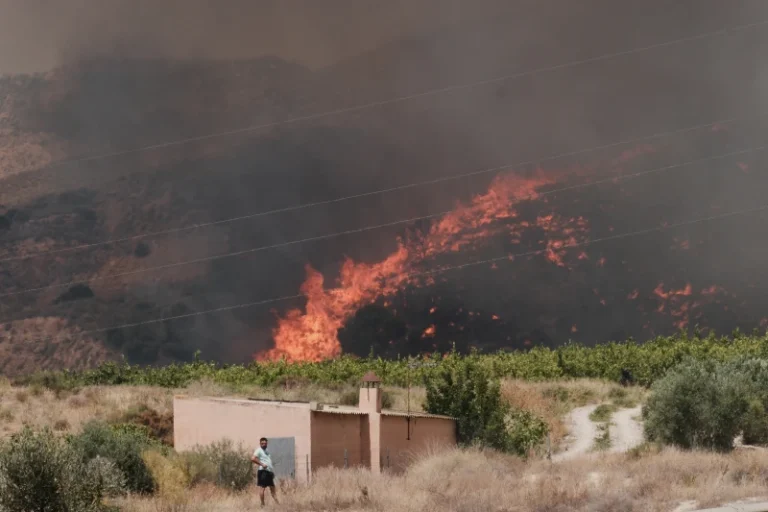
Madrid— A wildfire tore through a remote expatriate community in southern Spain overnight, leaving at least 12 dead as victims attempted to flee the flames in cars and on foot, authorities reported on Friday. Eight people were injured and 23 are missing, stated the President of the Regional Government of Andalusia, Juan Manuel Moreno.
The fire, one of the deadliest in Spain, broke out late Thursday in a semi-arid area near the Sierra de Los Filabres, in the province of Almería, at a time when the country is facing a heatwave.
Most of the victims died after ignoring confinement instructions, stated Antonio Sanz, head of Andalusia’s emergency services. Some tried to escape through a dry riverbed that “turned into a death trap,” he added.
According to regional authorities, four of the victims are believed to have been British citizens, as the steering wheel of their burnt-out car was on the right, as in British vehicles. It is also believed that the deceased include people of other unspecified nationalities, and the death toll is expected to rise.
We recommend reading:12 dead and 8 injured in a fire in southern Spain, the most serious to date
Sanz stated that seven people died while walking after abandoning their cars, and added that it is believed that most of the deceased were foreigners.
Dean Taylor, a resident who splits his time between Spain and the UK, said he managed to escape the neighborhood by the skin of his teeth by using back roads to get out.
“It was pretty scary,” Taylor said in an interview with the Associated Press. “It’s a very sad day, right? It’s devastating, really.”
The fire poses a challenge for the firefighters.
The fire was still active on Friday afternoon. About 150 firefighters and 220 soldiers from the Spanish military emergency unit were fighting the flames, which had consumed more than 3,200 hectares (7,900 acres) of forest and farmland.
Moreno, the regional leader of Andalusia, stated that containing the fire was difficult due to the steep and dry terrain.
“It is mainly composed of scrubland and esparto grass,” said Moreno. “Everything is extremely dry due to the heat waves, which makes it the perfect fuel; combined with the wind, it is a ticking time bomb.”
The President of the Spanish Government, Pedro Sánchez, expressed his condolences. “Immense sadness and desolation at the terrible consequences of the fire affecting the province of Almería,” he wrote on X.
Europe is once again fighting against intense heat.
Spain has suffered frequent and severe heat waves in recent years, with temperatures often exceeding 40 °C (104 °F). Wind, high temperatures, and a lack of rain contribute to small forest fires becoming large, uncontrollable blazes.

In June, Spain experienced several days of record heat, with more than 1,000 additional deaths attributed to the heat.
Subscribe to Morning Wire: our flagship newsletter breaks down the biggest stories of the day.Email AddressSign Up
Europe is the fastest-warming continent in the world, with temperatures rising at twice the global average since the 1980s, according to the European Union’s Copernicus Climate Change Service. Some areas of Western Europe are facing their third heatwave in six weeks. Globally, 2025 was the third hottest year on record, with several intense heatwaves across Europe.
France is also at risk of forest fires.
France is experiencing the peak of its third heatwave of the summer, with temperatures reaching 40°C (104°F) in western and central areas, and around 37°C (98°F) in Paris.
French authorities have also warned of a very high risk of forest fires, as large fires in the south of the country have razed thousands of hectares this week, disrupting the Tour de France cycling race and overstretching firefighting resources.
The largest forest fire, in the eastern Pyrenees near the Spanish border, had decreased in intensity on Friday, according to authorities. However, it has razed about 5,000 hectares (12,000 acres) and forced the temporary evacuation of more than 10,000 people from nearby towns.
Last month was the hottest June on record in France, with an increase of almost a third in the number of deaths during the hottest week.
Scientists warn that climate change, caused in part by the burning of fuels such as gasoline, oil, and coal, is exacerbating the frequency and intensity of heat and drought, making certain regions more vulnerable to wildfires.
Spain and Portugal have already faced devastating fires before.
Spain is no stranger to forest fires; last year’s fire season razed more than 393,000 hectares (almost 1,520 square miles), according to the European Forest Fire Information System, an area twice the size of London. Four people lost their lives.
Spain’s deadliest forest fire occurred in 1979, when 21 people lost their lives in Lloret de Mar, a coastal town located an hour north of Barcelona.
In 2017, a forest fire in neighboring Portugal left 66 people dead in Pedrogao Grande, located 200 kilometers (120 miles) northeast of Lisbon. In that fire, 47 people died on a road while trying to flee in their cars.
——